BEHIND-THE-SCENES

DREAMHACK ATL: AN UNLIKELY RESEARCH SETTING

BEHIND-THE-SCENES

DREAMHACK ATL: AN UNLIKELY RESEARCH SETTING

Action Games and Cognitive Performance
LAB NOTES

STUDY OVERVIEW

  • Sample: 150+ participants, 2 groups – action video game players (AGVPs) & non-video game players (NVGPs)

  • Tests:  The Stroop Test & Trail-Making Test

  • Goal: Try to determine if unique cognitive profiles are present and/or  information processes differ between AGVPs vs NVGPs 

  • Findings:

  • AGVPs – faster response times & superior task-switching abilities on both tests

  • AVGPs – prioritize speed over accuracy, made more errors than NVGPs in Stroop test tasks

  • AVGPs – faster at Trail-Making Test tasks without significant increase in error amount

  • AVGPs – higher weekly playtime showed better cognitive performance, >23 hours weekly playtime performed best on both tests

  • Conclusion: Possible useful applications of action video gameplay to enhance cognitive functions like task-switching & visual processing. However, the speed-accuracy trade-off in inhibitory tasks to be considered, especially in contexts requiring precise cognitive controlise cognitive control
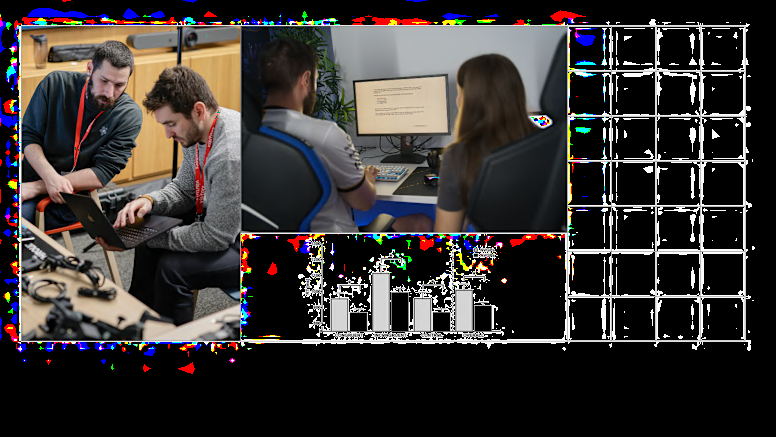
The LERO Esports Science Research Lab (ESRL), the first esports-focused performance testing lab in Europe, was established in 2016 as a multidisciplinary research team. Logitech G has partnered with LERO since 2018, leveraging the sole focus of scientifically understanding the minds and bodies of esports athletes.

One of the first outputs of the partnership was a 2018 LERO study titled “Different cognitive abilities displayed by action video gamers and non-gamers,” co-authored by Magdalena Kowala, Adam J. Toth, Chris Exton, and Mark J. Campbell. The study explored years of research on interaction with first-person shooter (FPS) and multiplayer online battle arena (MOBA) games that may affect certain cognitive abilities.

The over 150 respondents were split into 2 groups: action video game players (AGVPs) & non-video game players (NVGPs).

Matching Colors & Clicking Numbered Dots

The barebones descriptions of both the Stroop Test and the Trail-Making-Test belie their value towards understanding the minds of gamers.

The Stroop Test presents participants with a colored rectangle or text, tasking them to identify the correct color of the text as fast as possible using predetermined keys. The challenge is its incongruence – the names of the colors might not match what they’re seeing on screen. The word “red” might appear in blue text, “green” might show up in yellow.

The brain desperately wants to read out the words first, but the cognitive skill to suppress that instinct to determine the actual color of the letters is what's being measured. Simply put, can participants’ ability to effectively filter information to stay on task when presented with distractions. 

The Trail Making Test (TMT-A) presented participants with randomly scattered circles, some of which numbered from 1 to 25. The task is to click them all in ascending order, recording both time-to-complete, order accuracy, and circle target accuracy.

A variant test, TMT-B, adds a layer of letters, which need to be clicked in alternating order (1>A>2>B) to complete the test. TMT-A tests visual search speed, while TMT-B tests cognitive flexibility – the ability to coordinate multiple tasks simultaneously.

Expected & Unexpected Results

The researcher's Stroop Test hypothesis was wrong. They expected AVGPs to display higher attentional inhibition – the ability to filter the literal meaning of the words and focus on the color of the letters – however, their error rate was much higher. Could this be an example that playing action video games can “degrade” attentional inhibition? 

A realistic explanation suggests AVGPs pursued a different strategy to complete the task, prioritizing speed over perfect accuracy. In a competitive, high-stakes environment, milliseconds matter and can be the difference between victory and game over. ‘Fast and good enough’ out performs ‘second and perfect.’

Trail-Making Test results showed AVGPs to be much faster at finding the target letters and clicking them in order, having both a lower time-to-complete and error rate than the non-gamer participants. This result suggests AVGPs were not as distracted by empty circles and had fewer difficulties switching between the number and letter sequences. There was also a clear correlation between average-hours-played-per-week and time-to-complete, indicating that more interaction with action games sharpens those skills.

Needs Further Study

The research and methods did have its limitations, as noted by the authors, and further research is needed. Much testing was done at trade fairs and while events offered the access to a wide variety of action video gamers of all skill levels, the setting could have impacted the participants’ concentration to some degree.

A controlled and standardized environment was recommended for future studies. Tests also did not control for the varying degrees of participants’ proficiency in mouse and keyboard handling. 

Tracing players’ decision making is only a piece of the puzzle that is performance testing. Logitech G and the LERO Esports Science Research Lab have only deepened their partnership ever since – exploring many facets of pro athlete performance in order to understand exactly what makes action gamers different and how their gear can turn them from different to exceptional.